- Physical Intelligence’s π0.7 robot brain achieved ~100% success on tasks with zero training data, matching a human teleoperator with 375+ hours of experience on a UR5e robotic arm it was never trained on.
- The generalist model outperformed its own specialized predecessor by 1.5x throughput on laundry folding and hit ~100% across all comparison tasks — the first time a generalist has comprehensively beaten a specialist in robotics.
- Physical Intelligence’s valuation doubled from $5.6B to $11B in four months, with the broader Physical AI market projected to reach $3.26 trillion by 2040.
One hundred percent. That was the success rate when Physical Intelligence’s latest robot brain attempted tasks it had never been trained on — zero relevant data, zero prior demonstrations on the target hardware.
The company published its π0.7 results on April 16, 2026, calling the model a “step-change in generalization” for robotic foundation models. Even the research team admitted the zero-shot transfer capability “caught them off guard,” according to TechCrunch — a rare concession from scientists who typically hedge their claims with caveats.
Physical Intelligence, now negotiating an $11 billion valuation after doubling its worth in four months, didn’t build another narrow-purpose automation tool. It built a generalist system that outperforms its own specialist models, processing laundry 1.5 times faster than the company’s dedicated reinforcement-learning system while maintaining near-perfect accuracy across 14 distinct household tasks.
What 100% Actually Means
The number demands context before it can fully register. π0.7 achieved approximately 100% success on tasks where it had literally zero training data for that specific task-and-robot combination — a capability known in the field as zero-shot transfer.
The most striking demonstration involved a UR5e robotic arm folding laundry. The model had never been trained on that particular pairing of task and hardware, yet it matched the performance of a specialist human teleoperator with more than 375 hours of hands-on experience — months of dedicated practice condensed into a machine that learned the skill by inference alone.
Physical Intelligence’s researchers described the result as genuinely unexpected. TechCrunch reported that the zero-shot performance “caught them off guard,” suggesting the model’s generalization capabilities exceeded even the team’s internal projections for what the architecture could accomplish at this stage.
Why this matters: if a foundation model can match human-level dexterity on tasks it was never specifically trained for, the traditional approach of building narrow, task-specific robotic systems faces a fundamental question about its long-term viability. The cost of programming each new task individually starts to look like an engineering dead end.

The Generalist Robot Brain That Beat the Specialist
A persistent assumption in machine learning holds that specialized models will always outperform general-purpose ones on their home turf. π0.7 obliterated that assumption with data that leaves little room for debate.
On laundry folding, the generalist model achieved 1.5 times the normalized throughput of π0.6, Physical Intelligence’s own reinforcement-learning specialist — a system purpose-built and fine-tuned exclusively for that task. Across every other comparison benchmark, from espresso preparation to box assembly, π0.7 matched or exceeded the specialist with near-perfect success rates.
This marks the first documented instance of a generalist robotic model comprehensively outperforming its specialized counterpart across a full suite of tasks. The result is not a marginal improvement on one metric — it is a systematic demonstration that breadth and depth are no longer mutually exclusive in robotic AI.
Put simply, the economic implication for robotic deployment at scale is direct: if a single foundation model can replace an array of task-specific systems, companies no longer need to develop, maintain, and update dozens of narrow models for each individual use case. That collapse in complexity could compress adoption timelines across manufacturing, logistics, and household robotics.
From Espresso to Air Fryers — 14 Tasks Across the House
π0.7 demonstrated proficiency across 14 distinct household tasks, spanning three broad categories that collectively represent the messy, unpredictable reality of domestic environments. The range signals ambition: this is not a model optimized for a single controlled scenario.
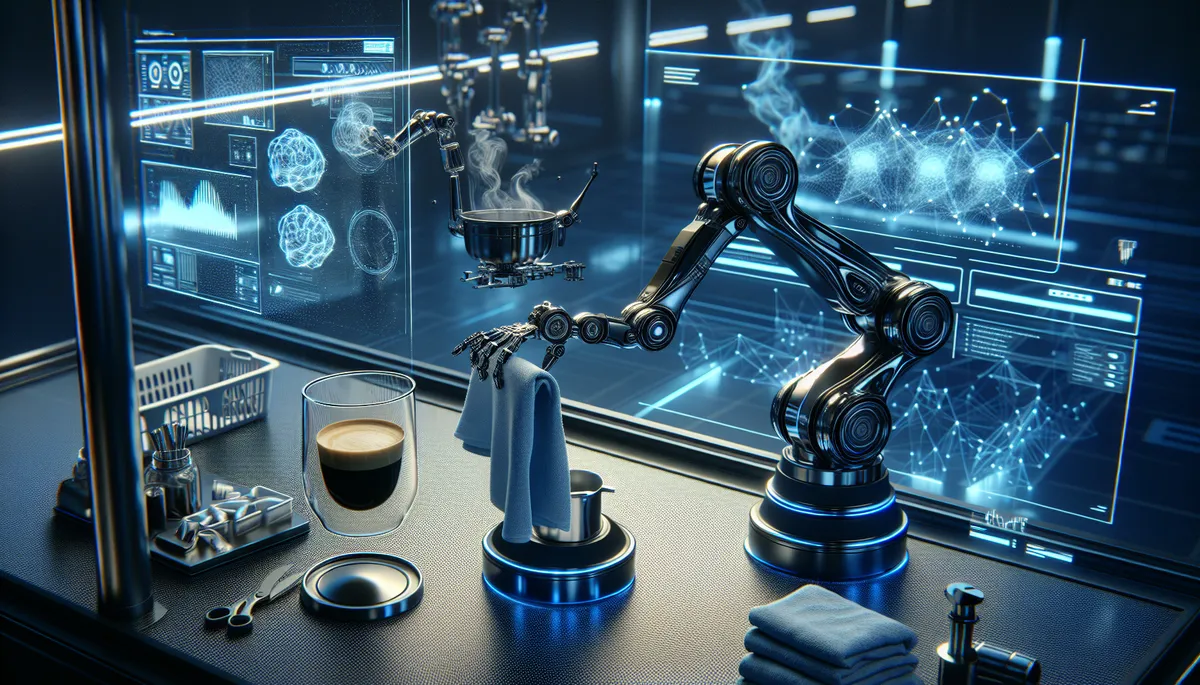
Kitchen tasks included operating an air fryer, pulling espresso shots, peeling vegetables, cutting squash, and assembling peanut butter sandwiches. Each involves different grasping strategies, different levels of force sensitivity, and different visual recognition demands — a butternut squash and a glass espresso cup require fundamentally different handling approaches.
Household chores covered folding T-shirts, shorts, jeans, and towels, taking out trash, flipping clothes inside-out, and cleaning glass doors. Precision tasks rounded out the demonstration: assembling pinwheels, installing screws, and opening and navigating through doors.
The breadth matters as much as any individual success rate. A single robot brain handles all 14 tasks without task-specific retraining, which separates π0.7 from prior robotic systems designed around narrow competencies. For the emerging Physical AI market, that distinction separates a research curiosity from a potential commercial foundation layer.
Compositional Generalization — Robotics’ ChatGPT Moment
The technical mechanism driving π0.7’s versatility is what researchers call compositional generalization — the ability to combine skills learned in entirely separate contexts to solve problems the model has never encountered before. The air fryer task provides the clearest illustration: π0.7 had zero training data for air fryer operation, but it merged knowledge from web-scale vision-language pretraining with a minimal number of robotic manipulation episodes to execute the task on its first attempt.
Under the hood, π0.7 operates as a Vision-Language-Action model, or VLA (a model architecture that unifies visual perception, language understanding, and physical action planning in a single framework). It generates visual subgoals through an integrated world model and accepts language commands, metadata, and visual prompts as inputs — a multimodal pipeline that enables the compositional flexibility underlying its zero-shot performance.
Co-founder Sergey Levine framed the significance in an interview with TechCrunch. “Once the model starts remixing the data, capabilities grow superlinearly relative to the amount of data,” he said — a claim that, if validated at scale, implies each additional training task makes the entire system disproportionately more capable at everything else.
The takeaway: the parallel to large language models is intentional. Just as LLMs crossed a threshold where they could handle instructions never explicitly present in their training data — the inflection point that ultimately produced ChatGPT — π0.7 suggests robotic AI has reached its own comparable transition, where generalization itself becomes the primary capability rather than a secondary byproduct.

$5.6B to $11B — Valuation Doubles in Four Months
Capital markets have responded with unusual velocity. Physical Intelligence’s valuation surged from $5.6 billion in November 2025 to $11 billion in March 2026 negotiations, according to Bloomberg — a doubling in roughly four months that reflects deep investor conviction about the generalist approach to robotic AI.
A $1 billion new funding round is actively under discussion, with Founders Fund and Lightspeed among the prospective participants. The company’s existing investor roster reads like a concentration of tier-one venture capital: Sequoia, Khosla Ventures, NVIDIA NVentures, CapitalG, and T. Rowe Price.
Physical Intelligence has now raised more than $1.1 billion in total funding, including a $600 million Series B led by CapitalG in November 2025. The pace of capital accumulation mirrors the broader acceleration of AI infrastructure spending across the technology sector, where companies are deploying multi-billion-dollar bets on foundational AI capabilities well before commercial revenue models are fully validated.
In short, Physical Intelligence’s funding trajectory signals that investors are not simply betting on a promising robotics startup. They are positioning around a potential platform — the foundational infrastructure layer for physical AI — where the generalist model itself becomes the product that every downstream application depends on.
The $3.26 Trillion Physical AI Market Opens
The investment thesis extends well beyond a single company’s trajectory. The global AI robotics market is projected to grow from $20.4 billion in 2025 to $182.7 billion by 2033, representing a compound annual growth rate of 32%, according to Grand View Research.
The broader Physical AI market — a category encompassing robots, autonomous vehicles, and AI-driven physical systems — is forecast to reach $383 billion in 2026 and $3.26 trillion by 2040, per Future Markets Inc. These projections place Physical Intelligence’s robot brain not as an isolated research achievement but as an early infrastructure layer for a multi-trillion-dollar transformation in how machines operate in the physical world.
One significant caveat tempers the optimism, however. The robotics field lacks standardized benchmarks — a gap the researchers themselves acknowledged, according to TechCrunch. Without industry-wide evaluation standards, π0.7’s performance claims rest entirely on self-reported comparisons against Physical Intelligence’s own prior models, and no independent party has verified the headline numbers.

π0.7 is a research result, not a commercial product — a distinction worth remembering as capital floods into Physical AI at unprecedented rates. The absence of industry-wide benchmarks means every startup’s headline claims exist in a verification vacuum, and investors are pricing in generalization capabilities that have yet to survive the chaos of uncontrolled, real-world deployment at commercial scale.
Two developments deserve close attention in the months ahead. The first: whether Physical Intelligence closes its billion-dollar round at the reported valuation, confirming that capital markets fully endorse the generalist robot brain thesis even without independent validation. The second: whether the robotics community establishes the standardized benchmarks needed to verify zero-shot performance claims — something that would either cement or deflate the narrative driving the sector’s most aggressive valuation.
Humanoid Robot Gig Economy and Training Data in 2026
Oracle’s 30,000 Layoffs and $156B AI Infrastructure Bet
References
- Physical Intelligence (2026-04-16) — π0.7 model announcement describing a “step-change in generalization” for robotic foundation models
- Physical Intelligence (2026-04-16) — ~100% success rate across laundry, espresso, and box assembly; 1.5x normalized throughput vs π0.6 specialist model
- Physical Intelligence (2026-04-16) — Zero-shot laundry folding on UR5e matching 375+ hour teleoperator; VLA architecture with visual subgoal generation
- Physical Intelligence (2026-04-16) — Compositional generalization via web-scale pretraining; 14 demonstrated household tasks
- TechCrunch (2026-04-16) — Researchers “caught off guard” by zero-shot transfer; Sergey Levine on superlinear capability growth
- TechCrunch (2026-04-16) — Absence of standardized benchmarks in robotics acknowledged by researchers
- Bloomberg (2026-03-27) — Physical Intelligence valuation surge from $5.6B to $11B in four months
- TechBuzz AI / Mezha (2026-03) — $1B new round with Founders Fund and Lightspeed; existing investor roster
- The Robot Report (2025-11) — $1.1B+ cumulative funding, $600M Series B led by CapitalG
- Grand View Research (2026) — AI robotics market projected $20.4B (2025) to $182.7B (2033), CAGR 32%
- Future Markets Inc. (2026) — Physical AI market projected $383B (2026) to $3.26T (2040)
Stay Ahead of the Curve
Get the latest insights on AI, tech, and markets — delivered in both Korean and English.

Jugger | Backend Developer
A backend engineer working in enterprise solutions software since June 2021. The hands-on perspective from system design, API implementation, and production operations directly informs this site’s
AI, IT, and cloud infrastructure coverage.
For topics outside direct professional experience—blockchain and macroeconomics—analysis is built on primary-source citations such as SEC filings, whitepapers, institutional research, and government
statistics. Speculation is clearly separated from verified fact, and unverified claims are not published.
AI tools assist with drafting, but every article is reviewed, revised, and verified before publication. Errors are corrected with visible notes when discovered.
Contact: jjunggulee@gmail.com