- Amazon agreed to acquire satellite operator Globalstar for $11.57B ($90/share) — directly challenging SpaceX Starlink’s 10,000-satellite dominance
- The real prize: Band 53 exclusive spectrum (2483.5–2495 MHz) licensed in 120+ countries, already compatible with mainstream smartphone chips
- Apple retains its 20% Globalstar stake and 85% network capacity — Amazon inked a separate deal to maintain and expand iPhone satellite services
$11.57 billion. That is the price tag Amazon just placed on its satellite war with SpaceX. On April 14, Amazon announced a definitive agreement to acquire Globalstar, the satellite communications operator that powers Apple’s iPhone Emergency SOS feature, in what amounts to the largest satellite industry acquisition in history.
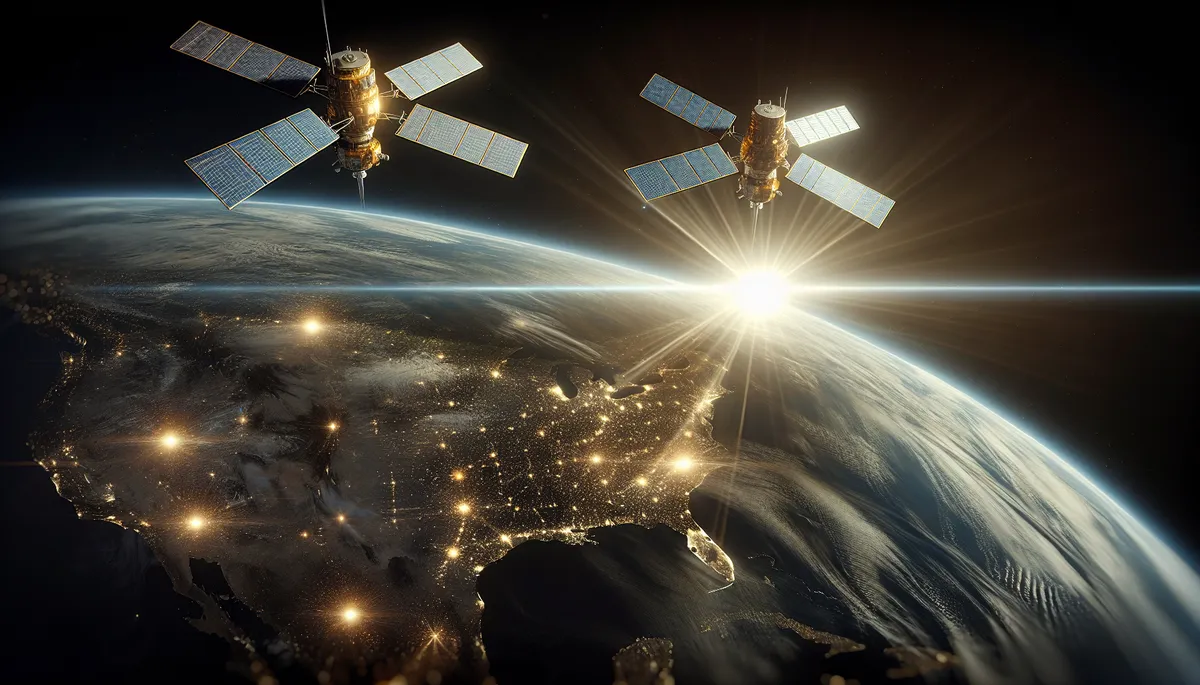
Amazon Leo — the company’s low-Earth orbit satellite venture — currently operates just 241 satellites. SpaceX Starlink has roughly 10,000 in orbit, a 40-to-1 advantage that makes this look like a lopsided fight on paper. But the deal’s real value lies not in satellite counts but in something far scarcer: exclusive spectrum rights.
Globalstar holds Band 53, a globally licensed midband frequency that mainstream smartphone chips already support. That means Amazon can pipe data directly from satellites to ordinary phones — no specialized hardware required. Amazon SVP Panos Panay framed the acquisition’s ambition bluntly: “There are billions of customers out there living, traveling, and operating in places beyond the reach of existing networks.”
Anatomy of an $11.57 Billion Satellite War Deal
Under the merger agreement, Globalstar shareholders will receive $90 per share in either cash or 0.321 shares of Amazon common stock. The total aggregate cash component is capped at 40%, with any excess elections automatically converting to stock. The deal is expected to close in 2027, subject to regulatory approvals and certain satellite operational milestones.
Amazon built in downside protection as well. If Globalstar fails to meet specified operational milestones before closing, the acquisition price faces a maximum downward adjustment of $110 million. On the governance side, shareholders representing 58% of Globalstar’s voting power have already delivered written consent approving the transaction.
One detail that underscores the strategic urgency: SpaceX reportedly explored acquiring Globalstar in November 2025 before Amazon moved first. Amazon effectively outmaneuvered Elon Musk’s satellite empire for one of the last independent satellite operators with globally licensed D2D spectrum — a resource that cannot be replicated or manufactured.
241 vs. 10,000: The Satellite Gap in Context
The raw numbers tell a stark story. As of early April 2026, Amazon Leo operates 241 satellites. SpaceX Starlink has approximately 10,000 in orbit. The gap exceeds 40-to-1, and Globalstar’s addition of roughly 24 operational satellites barely moves the needle, bringing Amazon’s total to around 265.
Amazon has outlined a more ambitious roadmap: an initial constellation of 3,000-plus satellites with deployment targeted by 2029. Even that figure pales next to Starlink’s existing fleet, but the strategic calculus here is not about matching SpaceX satellite-for-satellite. It is about opening a different battlefield entirely.
Amazon’s financial muscle makes the long game viable. The company’s annual capital expenditure plan totals $200 billion, and AWS alone generated $35.58 billion in Q4 revenue, a 24% year-over-year increase. That kind of cash flow can sustain a multi-year satellite deployment campaign even if early returns are negligible. The broader pattern of Big Tech making massive infrastructure bets is well established.
Band 53 Spectrum: The $11.57B Deal’s Real Trophy
Buried inside Globalstar’s balance sheet is arguably the most valuable asset in the entire satellite war: Band 53. Technically designated n53, this midband spectrum occupies the 2,483.5 to 2,495 MHz range. Globalstar holds exclusive licenses for this frequency band, with mobile satellite service (MSS) authorizations spanning more than 120 countries worldwide.
What makes Band 53 strategically irreplaceable is its optimization for direct-to-device (D2D) connectivity. The spectrum delivers low-latency, high-performance, interference-free connections — characteristics that Globalstar describes as purpose-built for connecting satellites directly to consumer devices. Unlike higher-frequency bands that require specialized ground equipment, Band 53 operates in a sweet spot that balances coverage, penetration, and data throughput.
The critical commercial fact: mainstream smartphone chipsets already support Band 53. No new hardware, no specialized satellite phone, no dongles — an ordinary smartphone can connect to a Band 53 satellite signal out of the box.
That zero-friction adoption path is what separates this spectrum from every other satellite frequency in commercial use. It eliminates the biggest barrier to satellite internet adoption at the consumer level.
Scott Bickley of Info-Tech Research Group weighed in on the spectrum’s strategic value: “Globalstar has valuable L-band and S-band licenses, which are well-suited for direct to device connectivity. This alone can compress Amazon’s timeline by several years.” He added a caveat, however: the acquisition “doesn’t materially close the gap with SpaceX,” given Starlink’s vertically integrated launch-and-operate model.
Apple’s $1.5B Stake: iPhone Satellite Services Under New Management
Apple is the most consequential third party in this deal. In 2024, Apple invested $1.5 billion in Globalstar, acquiring a 20% ownership stake and securing priority access to 85% of the network’s total capacity. That infrastructure currently powers satellite-based Emergency SOS, Messages via satellite, Find My, and Roadside Assistance on iPhone 14 and later models, as well as Apple Watch Ultra 3.
Amazon addressed Apple’s interests directly. Alongside the Globalstar acquisition, Amazon and Apple signed a separate agreement to maintain satellite connectivity for all current iPhone and Apple Watch features. The agreement goes further: the two companies will collaborate on future satellite services using Amazon Leo’s expanded network — effectively giving Apple a next-generation satellite partner without Apple having to build its own constellation.
Roger Entner of Recon Analytics characterized the Globalstar acquisition as “a powerful counter move against Starlink, and its mobile, direct to device initiatives.” The Amazon-Apple-Globalstar triangle creates a competitive dynamic that SpaceX’s Starlink, for all its scale, has not faced before: a combined front of the world’s most valuable company (Apple) and one of its most capital-rich (Amazon).
D2D 2028: Amazon’s Next-Generation Satellite System
Amazon plans to begin deploying its next-generation direct-to-device (D2D) satellite system in 2028. Unlike current satellite services — which are limited to emergency text messaging and low-bandwidth signaling — the D2D system aims to deliver voice, data, and messaging directly to standard smartphones without requiring any specialized hardware or antenna.
According to Amazon’s official announcement, the next-generation system will achieve “substantially higher spectrum use and efficiency” compared to legacy direct-to-cell (D2C) systems currently in use. The architecture integrates Globalstar’s first, second, and third-generation LEO satellite systems into a unified network designed for seamless handoffs and continuous coverage.

The target market is deliberately broad: consumer, enterprise, and government customers on a global scale. Amazon projected the addressable audience at “hundreds of millions” worldwide. Anshel Sag of Moor Insights & Strategy noted that “Amazon is betting on direct to device at scale, and if that works, the addressable market extends well beyond traditional satellite broadband.”
MDA Space currently manufactures Globalstar’s LEO satellite constellation, and that manufacturing relationship transitions to Amazon with the acquisition. Whether Amazon will vertically integrate satellite production — as SpaceX does — or continue outsourcing to MDA remains an open question.
Wall Street’s Verdict: Gamble or Masterstroke?
Markets delivered an initial thumbs-up. Amazon shares rose 5% on the announcement, while Globalstar (GSAT) surged 10%, extending an annual return of +273%. The market read the deal not as a cost center but as a strategic asset acquisition — a bet on the satellite war’s next front rather than a sunk cost in catching Starlink.
Deutsche Bank called the Globalstar acquisition the “second pillar” of Amazon’s space strategy, complementing the existing Project Kuiper broadband constellation. Globalstar CEO Paul Jacobs reinforced the strategic rationale: “Low Earth orbit satellite constellations offer the most effective path to truly connect” the world’s unserved population.
The bull case is straightforward. Amazon gets exclusive D2D spectrum that cannot be replicated, a built-in relationship with Apple covering hundreds of millions of iPhone users, and a 2028 timeline for a next-generation satellite system that promises superior spectrum efficiency. Backed by a $200 billion CapEx machine and AWS’s $35.58 billion quarterly cash flow, Amazon can sustain this bet for years.
The bear case is equally clear. As Bickley cautioned, the acquisition “doesn’t materially close the gap with SpaceX” — Starlink operates roughly 10,000 satellites while Amazon Leo has not yet reached commercial service.
The 241-to-10,000 gap is real, and the 2028 D2D timeline introduces execution risk that no amount of capital can entirely eliminate. The satellite war’s outcome will depend on whether spectrum advantages can outweigh a massive scale deficit.
Two milestones will determine whether this $11.57 billion bet pays off. First, the 2027 regulatory approval and transaction close — any antitrust complications or satellite milestone failures could reduce the deal value by up to $110 million or delay the timeline entirely. Second, the 2028 D2D system launch, which must prove the “substantially higher spectrum efficiency” Amazon has promised.
If the D2D system delivers, Amazon will have built a satellite war machine that competes on fundamentally different terms than Starlink: not more satellites, but smarter spectrum connecting directly to the phones already in three billion pockets. If it does not, $11.57 billion becomes one of the most expensive bets in the history of space telecommunications.
Musk’s Terafab: A $20B Bet to Build Chips and Cut Out TSMC
Google Antitrust Reckoning: $218B Claims as DOJ, EU Close In
References
- Amazon Official (2026-04-14) — Amazon-Globalstar merger agreement: $11.57B at $90/share, Apple partnership, D2D 2028 timeline
- Amazon Official (2026-04-14) — Deal structure: 40% cash cap, $110M milestone adjustment, 58% shareholder consent
- Amazon Official (2026-04-14) — Panos Panay quote on billions of customers beyond existing networks
- The Register (2026-04-14) — Amazon Leo 241 satellites vs. Starlink ~10,000; Globalstar 24 satellites; Band 53 spectrum details
- TechCrunch (2026-04-14) — Amazon Globalstar acquisition background and Project Kuiper deployment status
- 24/7 Wall St (2026-04-14) — AMZN +5%, GSAT +10% market reaction; GSAT +273% annual return; Amazon $200B CapEx
- CNBC (2024-11-01) — Apple’s $1.5B Globalstar investment, 20% stake, 85% capacity commitment
- Network World (2026-04-14) — Analyst commentary: Roger Entner, Scott Bickley, Anshel Sag assessments
- Futunn/Deutsche Bank (2026-04-16) — Deutsche Bank: Globalstar as “second pillar” of Amazon’s space strategy
Stay Ahead of the Curve
Get the latest insights on AI, tech, and markets — delivered in both Korean and English.

Jugger | Backend Developer
A backend engineer working in enterprise solutions software since June 2021. The hands-on perspective from system design, API implementation, and production operations directly informs this site’s
AI, IT, and cloud infrastructure coverage.
For topics outside direct professional experience—blockchain and macroeconomics—analysis is built on primary-source citations such as SEC filings, whitepapers, institutional research, and government
statistics. Speculation is clearly separated from verified fact, and unverified claims are not published.
AI tools assist with drafting, but every article is reviewed, revised, and verified before publication. Errors are corrected with visible notes when discovered.
Contact: jjunggulee@gmail.com