Key Takeaways
- Framework’s Next Gen event goes live on April 21, 2026 at 10:30 AM PT in San Francisco, streaming globally on YouTube.
- The teaser shows five Linux distribution logos — Ubuntu, Fedora, Arch, CachyOS, and Bazzite — an unprecedented declaration for a consumer PC maker.
- CEO Nirav Patel said roughly half of Framework’s unit sales already ship as Linux systems on the Dualboot Diaries podcast.
- Laptop 13 starts at $849 (AMD Ryzen AI 300) and $1,049 (Intel Core Ultra 200V); Laptop 16 starts at $1,049; Desktop starts at $499.
- A 2021 Framework 13 chassis can still accept a 2026 mainboard — modular economics put on the table.
- Framework has raised roughly $44M across Seed, Series A, and Series A-1, reaching six-figure cumulative units as of October 2024.
Framework Laptop’s Next Gen event goes live today, April 21, 2026 at 10:30 AM PT in San Francisco. The company is streaming the keynote globally on YouTube and has publicly advised customers to hold new orders — a classic signal that refreshed hardware is on deck.
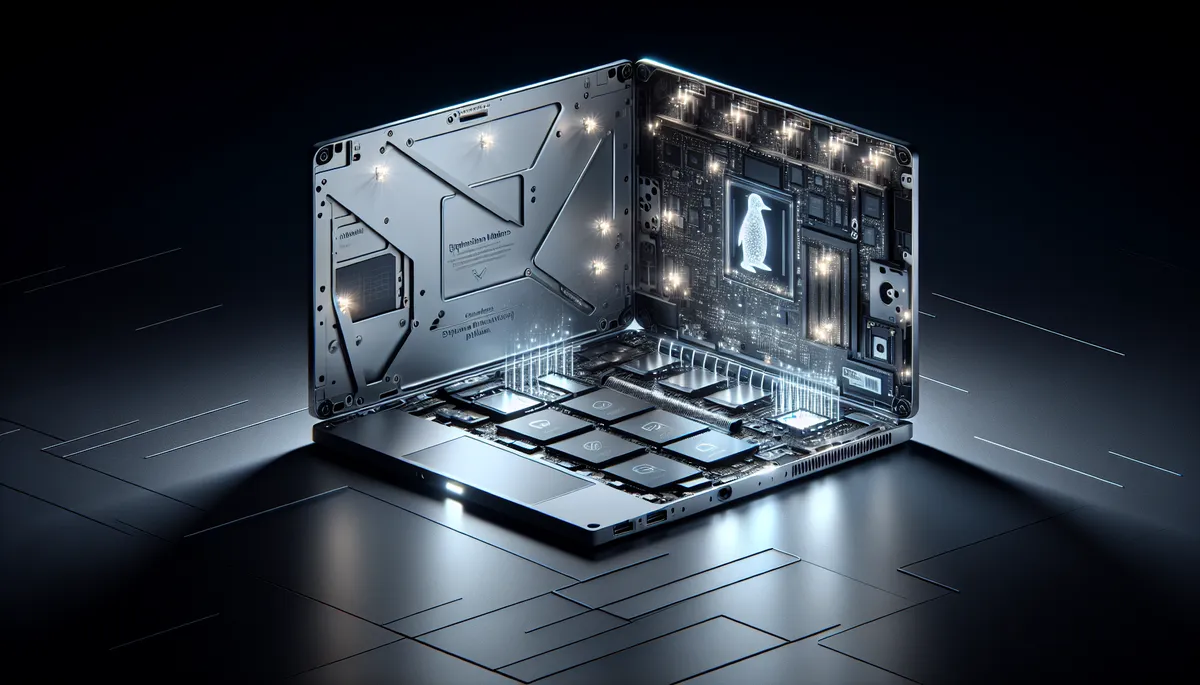
The event is officially titled “Next Gen,” and Framework’s teaser clip carries the tagline Follow the white penguin. Across that teaser, Framework lines up five Linux distribution logos — Ubuntu, Fedora, Arch, CachyOS, and Bazzite — and plants its flag in open-source terrain that mainstream US PC vendors have long treated as a fringe market.
10:30 AM PT Live: Framework’s Next Gen Event Kicks Off
Framework is streaming the Next Gen keynote live from San Francisco at 10:30 AM PT today. Digital Trends reports the company explicitly asked customers to pause pending orders — a pre-launch convention that usually telegraphs an SKU rotation.
The event name “Next Gen” and the teaser headline “Follow the white penguin” both point at Linux as the marketing center of gravity. For a company that still sells mainly to power users and developers, the teaser copy reads less like a product slogan and more like a cultural invitation.
What this means for US readers: Framework is not a dormant hobbyist brand anymore. It is running a consumer keynote with a structure that Apple and Microsoft would recognize — orchestrated livestream, fixed time slot, pre-event order freeze — while pointing the spotlight directly at an ecosystem most rivals barely name on stage.
The timing also matters. A keynote on a single fixed date, streamed globally, is the kind of demand-shaping tool traditionally reserved for incumbents with established installed bases. Framework running the same play is itself a statement about where the company now sees itself in the hierarchy.
Five Linux Distros on Stage: An Unprecedented Consumer PC Statement
GamingOnLinux captured the teaser closely and confirmed all five logos: Ubuntu, Fedora, Arch, CachyOS, and Bazzite. Including Arch-family and immutable distributions alongside Ubuntu and Fedora is without precedent among mainstream consumer laptop makers, where Dell’s Developer Edition has historically stuck to Ubuntu LTS.
CEO Nirav Patel told the Dualboot Diaries podcast that “about half of the company’s computer sales” are Linux systems. That number reframes Framework from a niche Windows OEM into a de facto Linux-first PC brand — one with a customer base that looks nothing like the Windows-dominated distribution curve of the broader laptop market.

Official Framework Linux support to date has centered on Ubuntu 22.04 LTS and Fedora 38/39. An Arch-family expansion would widen the firmware and driver validation surface, a costly commitment that most OEMs avoid. If the keynote confirms it, Framework will be betting that Linux share in its own customer base justifies the support cost.
Section takeaway: Framework is not simply shipping laptops that tolerate Linux. It is positioning five distributions — including the historically unsupported Arch and immutable Bazzite — as first-class environments, a stance no mainstream consumer PC vendor has matched.
Framework Laptop Lineup Unveiled: $849 Laptop 13, $1,049 Laptop 16, $499 Desktop
The Framework Laptop 13 starts at $849 with AMD Ryzen AI 300 silicon and $1,049 with Intel Core Ultra 200V, according to Vucense’s spec roundup. The 13.5-inch 2256×1504 120Hz display sits alongside up to 64GB DDR5, up to 8TB NVMe, and four Expansion Card slots that users physically swap.
The Framework Laptop 16 starts at $1,049 with a 16-inch 2560×1600 165Hz panel. What sets it apart is the user-replaceable AMD Radeon RX 7700S discrete GPU module — discrete graphics that slide in and out of a consumer laptop without a soldering iron.
The Framework Desktop starts at $499 excluding RAM and storage. It shares the same AMD Ryzen AI 300 mainboard as the Laptop 13 — a design choice that lets a single component flow between form factors as the owner’s needs change, instead of locking silicon into a single chassis.
Across all three products, the $849 entry point matters as much as the spec sheet. Framework is anchoring the lineup well below premium Apple and Dell pricing, while offering an upgrade path that keeps the chassis when the chip moves on.
The Laptop 16 is the tell for where Framework’s engineering ambitions actually sit. Putting a user-swappable discrete GPU module on a consumer laptop reworks the thermal and power delivery stack that most OEMs prefer to lock down, and the DDR5 ceiling at 96GB is already at workstation territory rather than a creator-class laptop one.
Analogy: Traditional laptops sell like packaged meals — one box, one fixed menu, one disposal point. Framework sells like a kitchen upgrade — the counters, plumbing, and cabinets stay, and you only replace the appliance that actually went stale.
2021 Chassis, 2026 Mainboard: Modular Economics Made Real
Vucense notes that a Framework 13 chassis purchased in 2021 can accept a 2026-generation mainboard without a new chassis. The upgrade economics therefore route around the most expensive physical parts of a laptop — display assembly, hinge, keyboard deck, and port layout.
Published replacement prices make the math explicit: mainboards $349–599, batteries $49, displays $129, keyboards $49, webcams $29, and speakers $19. A five-year-old unit can receive a new mainboard for the price of a mid-range tablet, not a new computer.
Related read — this is not the first time upstream silicon has been the constraint for US laptop pricing. For the cost-side view, see TSMC’s 4-Year Chip Price Hike: The End of Cheap Silicon Through 2026.
The Expansion Card system extends the same logic outward. Four rear slots accept USB-C, USB-A, DisplayPort, HDMI, SD, MicroSD, Ethernet, or 3.5mm headphone modules — swappable in seconds, without a dongle bag or a dock tax.
That component-level pricing is itself the product. When every swap cost is public and every part is sold separately, the lifetime cost of ownership stops being a black box and starts looking like a maintenance bill on something the buyer actually owns.
Six-Figure Sales and $44M Raised: From Niche to Growth Trajectory
Community-tracked sales estimates place Framework at cumulative six-figure units (between 100,000 and 999,999) as of October 2024. The global laptop market runs at roughly $195.5 billion in 2026 revenue and is dominated by Lenovo, HP, Dell, Apple, and ASUS — Framework is still outside that top group by a wide margin.
The funding timeline tells the narrower story. Seed round of $9M in 2021, Series A of $18M in 2022 with Spark Capital leading, and Series A-1 of $17M in April 2024 with Spark, Buckley Ventures, Anzu Partners, Cooler Master, and Pathbreaker Ventures participating. A $1M community round sized for roughly 100 retail investors rounded out the A-1 — cumulative capital sits near $44M.
In early 2026 Framework added direct sales in New Zealand, Norway, Switzerland, and Singapore. Four national expansions in a single window suggests the company is now capacity-limited on markets, not demand — a very different posture from the 2021-era Reddit-and-Crowd-Supply image many readers still carry.
Section takeaway: Framework still reads as small next to Lenovo or HP. Relative to its own 2021 baseline — six-figure units shipped, $44M committed capital, four new countries in one quarter — the growth curve has clearly bent upward.
“Own It at the Deepest Level”: A Collision Course With Apple and Dell
Framework’s official blog defines the product as computers that you can own at the deepest level, where owners choose the OS, modify the hardware, and keep data and computation local rather than leased from the cloud. It positions ownership, not raw performance, as the primary axis of differentiation against Apple and Dell.
Founder Nirav Patel is an Apple software engineer alumnus who went on to become the first Head of Hardware at Oculus. He launched Framework in January 2020 after experiencing sealed-ecosystem hardware from the inside — context that makes the repair-first pitch read as a deliberate architectural rebuttal rather than a marketing angle.
Related read — the broader policy argument against sealed platforms is playing out in parallel. For US antitrust coverage, see Google Antitrust Reckoning: $218B Claims as DOJ, EU Close In.
Framework’s 2026 context matters for US buyers. The global laptop market revenue of $195.5 billion is still overwhelmingly sealed hardware by design — units engineered so that end users cannot practically open, repair, or upgrade them. Framework is arguing, with specs and prices rather than essays, that this design choice is a business choice and therefore reversible.
Analogy: A sealed laptop is like a pre-fabricated hotel room — convenient on day one, replaced whole when anything breaks. A Framework laptop is like a studio apartment you own — the plumbing and electrical are yours, and you pay to change a faucet rather than the building.
Investor and Buyer Checkpoint: From Promise to Product
Digital Trends framed the stakes by arguing that a meaningful Framework upgrade would strengthen modular computing as an alternative to the traditional hardware cycle. The keynote is therefore a test of execution rather than a proof of concept.
Three variables matter for US-based buyers and venture observers. First, which AMD and Intel SKUs actually ship and how close their pricing sits to the $849 and $1,049 anchors. Second, how far Linux support extends — whether Ubuntu and Fedora alone remain the officially backed pair or Arch, CachyOS, and Bazzite graduate beyond teaser branding.
Third, the Desktop and Laptop 16 roadmap. A more aggressive discrete-GPU cadence on Laptop 16 and a steady Ryzen AI lift on Desktop would widen Framework’s addressable segments into creator and light gaming workloads, which today still default to Apple Silicon or sealed gaming OEMs.
The public order-pause notice is a practical signal for anyone mid-purchase. Current AMD Ryzen AI 300 SKUs on Laptop 13 are the most likely candidates for replacement, and upgrade paths from those boards to the next-generation mainboard will determine whether the modularity pitch holds up for buyers who joined Framework in the past 12 months.
Related read — the US consumer PC buyer is navigating shifting economics more broadly. For a snapshot of how even AI-adjacent workforces are reshaping, see Snap Layoffs: AI Replaces 1,000 Workers, Stock Soars 8%.
References
- Digital Trends — I Like What Framework Is Promising, But It Needs To Deliver (2026-04-18)
- GamingOnLinux — Framework Tease New Hardware And It Seems Something Linux Related Too (2026-04-15)
- GamingOnLinux — Nirav Patel on Dualboot Diaries: “about half of sales are Linux systems” (2026-04-15)
- Vucense — Framework Laptop Next Gen April 21 Linux 2026 (2026-04-16)
- Vucense — Framework Laptop 16 spec sheet and pricing (2026-04-16)
- Vucense — Framework Desktop $499 starting configuration (2026-04-16)
- Vucense — Framework component replacement price list (2026-04-16)
- Wikipedia — Framework Computer: Funding History and Founder Background (2026-04)
- Framework Community / Market.us — Cumulative Sales and Global Laptop Market Size (2024-10)
Want more market-moving tech analysis?
Jugger Insight decodes what US and global tech launches actually mean for investors and operators — not just the press release. Bookmark our Tech category and come back for the next breakdown.

Jugger | Backend Developer
A backend engineer working in enterprise solutions software since June 2021. The hands-on perspective from system design, API implementation, and production operations directly informs this site’s
AI, IT, and cloud infrastructure coverage.
For topics outside direct professional experience—blockchain and macroeconomics—analysis is built on primary-source citations such as SEC filings, whitepapers, institutional research, and government
statistics. Speculation is clearly separated from verified fact, and unverified claims are not published.
AI tools assist with drafting, but every article is reviewed, revised, and verified before publication. Errors are corrected with visible notes when discovered.
Contact: jjunggulee@gmail.com