- NASA’s Perseverance rover completed a 456-meter Mars drive planned entirely by Anthropic’s Claude AI — the first AI-planned drive on another planet
- JPL’s digital twin simulated over 500,000 telemetry variables before transmitting commands, and engineers found only minor corrections needed
- Route planning time dropped by an estimated 50%, breaking the efficiency ceiling of 28 years of manual waypoint design
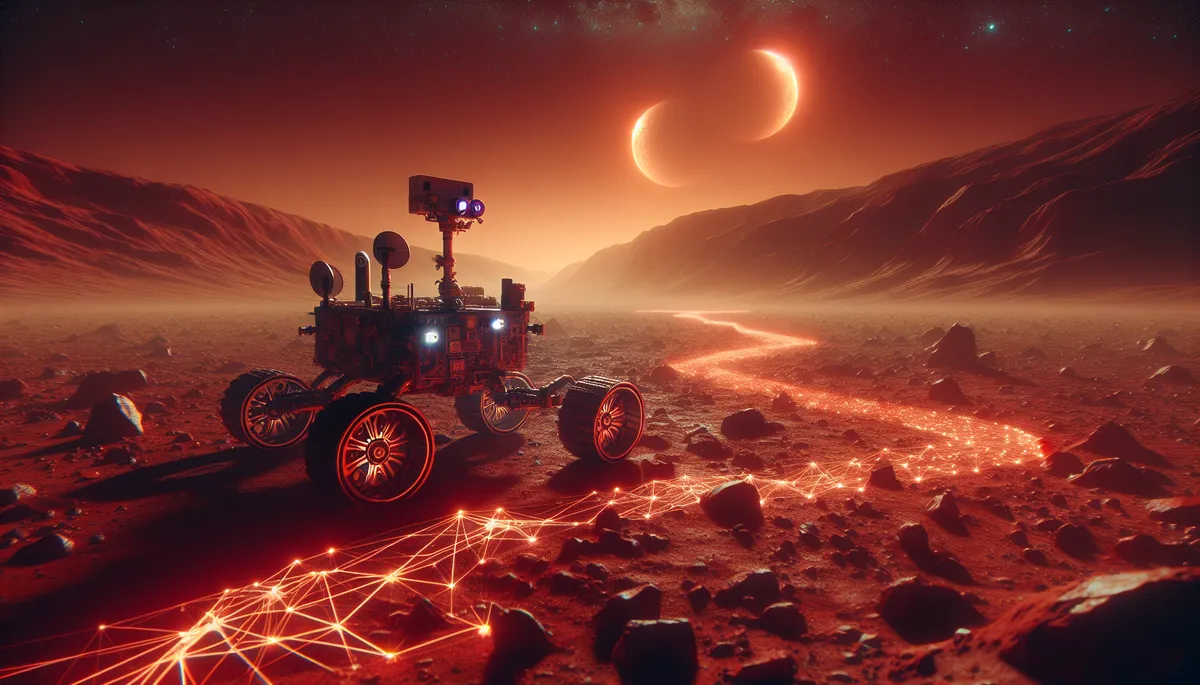
Four hundred fifty-six meters. That is how far a Mars drive planned entirely by artificial intelligence carried NASA’s Perseverance rover across the rocky rim of Jezero Crater in December 2025. For 28 years, every waypoint a Mars rover followed had been handpicked by human planners on Earth — until Anthropic’s Claude drew the route instead.
28 Years of Manual Navigation — and Why It Hit a Wall
Since Sojourner left the first wheel tracks on Mars in 1997, every rover drive has followed the same operational pattern. Engineers at NASA’s Jet Propulsion Laboratory study imagery from the previous sol (a Martian day), manually designate waypoints — the fixed coordinates where the rover picks up new instructions — and transmit commands through the Deep Space Network.
The bottleneck is physics, not talent. One-way signal travel between Earth and Mars takes up to 24 minutes, making real-time steering physically impossible. A single drive cycle — send commands, wait for execution, receive confirmation imagery — consumes an entire Earth day at minimum.
That cadence directly constrains how much ground a rover can cover during its operational lifetime. The faster JPL can plan a safe route, the more drives it can execute per week, and the more science data it can collect. For nearly three decades, the planning speed of human operators set the upper bound on exploration range.
The problem was not a lack of engineering talent — JPL’s rover planners are among the most skilled in the world. The constraint was structural: no amount of expertise can compress a 24-minute signal delay or eliminate the overnight wait for confirmation imagery. Breaking through that ceiling required removing the human planning step from the critical path entirely.
How Claude ‘Saw’ Mars — HiRISE Imagery and Vision-Language Models
JPL handed the route-planning task to Anthropic’s Claude, a vision-language model (VLM) capable of analyzing both images and text simultaneously. The data Claude processed was identical to what human planners use: HiRISE (High Resolution Imaging Science Experiment) orbital imagery and terrain-slope data extracted from digital elevation models.
Using those inputs, Claude automatically identified hazardous terrain features — bedrock outcrops, boulder fields, and sand ripples that could trap or destabilize the rover. It then generated a safe traversal path that avoided every flagged obstacle.
What makes this approach significant is not the creation of a bespoke AI system for space. JPL leveraged a general-purpose vision-language model, one already trained on broad datasets, and applied it to planetary navigation with no architectural changes. The demonstration proved that commercial frontier AI can match human-level route judgment when given the same mission data.
10-Meter Segments — Writing Rover Commands in Markup Language
Claude did not produce a high-level route sketch for engineers to translate into code. It divided the entire path into 10-meter segments and wrote executable commands directly in Rover Markup Language (RML), an XML-based programming language purpose-built for rover operations.
The model then ran a self-critique loop, reviewing its own waypoints and iteratively refining them before submission. This was not a single-pass generation — Claude repeatedly questioned its own routing decisions and adjusted coordinates where it detected suboptimal choices.
The technical implication is striking. In the traditional workflow, human planners design a route conceptually, then a separate step converts that plan into flight-software-compatible code. Claude collapsed both stages into a single pipeline, eliminating the translation layer entirely and reducing the surface area for human transcription errors.
500,000 Variables — How JPL Verified an AI-Planned Mars Drive
NASA did not simply upload Claude’s waypoints to the rover and hope for the best. Before any command was transmitted to Mars, JPL ran the entire drive plan through Perseverance’s digital twin — a virtual replica of the rover that simulates every mechanical and environmental interaction in granular detail.
The simulation modeled over 500,000 telemetry variables: projected rover positions at each waypoint, terrain collision probabilities, wheel traction estimates, and instrument clearances. Only after the digital twin confirmed zero critical failures did JPL transmit the commands via the Deep Space Network (DSN), NASA’s global array of ground antennas.
When JPL engineers reviewed Claude’s plans against the simulation results, only minor corrections were needed. Vandi Verma, a space roboticist at JPL, said: “The fundamental elements of generative AI are showing a lot of promise in streamlining the pillars of autonomous navigation.” The near-zero correction rate validated not just Claude’s routing accuracy, but the viability of vision-language models as a class of tool for planetary operations.
210 Meters Plus 246 Meters — Two Days of Live Driving Results
On December 8, 2025 (sol 1,707), Perseverance loaded Claude’s AI-generated waypoints into its onboard memory and drove 210 meters across the Jezero Crater rim. Two days later, on December 10 (sol 1,709), the rover executed a second AI-planned Mars drive of 246 meters, bringing the total to 456 meters.
The terrain was far from trivial. The Jezero Crater rim is a dense field of rocks, outcrops, and sand features that would challenge even experienced human planners. Perseverance navigated the entire stretch on AI-generated waypoints alone, with no human intervention during execution.
This result goes beyond a technology demonstration. For the first time, AI route planning was directly compared against 28 years of accumulated human expertise — and the AI’s output required only minor adjustments to reach flight-ready quality. That comparison establishes a credible baseline for shifting AI from an experimental tool to a primary planning method for future missions.

50% Faster Route Planning — A New Efficiency Benchmark
The most immediately quantifiable result from the demonstration is speed. AI-assisted route planning cut planning time by an estimated 50% compared to the traditional manual process.
In practical terms, halving the planning cycle means JPL can execute more drives per week without increasing headcount. More drives per week means more terrain covered, more rock samples analyzed, and more science data returned to Earth — all within the same mission timeline and budget.
NASA Administrator Jared Isaacson emphasized the strategic value of this breakthrough. “Autonomous technologies like this can help missions to operate more efficiently, respond to challenging terrain, and increase science return,” he stated. The 50% reduction is not a marginal optimization — it fundamentally changes the calculus of how much a single rover can accomplish during its operational window on Mars.
$25B Terafab: Musk’s Zero-Experience Bet Against TSMC
Artemis, Next-Gen Rovers, and the Future of AI-Driven Mars Drives
The implications of this demonstration extend well beyond Mars. Matt Wallace, manager of JPL’s Exploration Systems Office, described the technology as “the game-changing technology we need to establish the infrastructure and systems required for a permanent human presence on the Moon.” NASA’s Artemis program — which aims to build a sustained lunar base — will require autonomous vehicles to transport construction materials across unpredictable terrain, a task tailor-made for AI route planning.
Even on the Moon, where communication delays are measured in seconds rather than minutes, the sheer volume of autonomous cargo runs needed for base construction makes AI-driven navigation essential. Manual planning at scale would require staffing levels that no space agency budget can sustain indefinitely.
Concepts for the next generation of Mars rovers go further still, with proposals for AI-coordinated drone swarms that extend a rover’s exploratory reach across wider areas. The 456-meter Mars drive was a proof of concept. The two metrics worth tracking from here are how quickly AI-planned drive distances scale on active missions and when next-generation rover designs ship with AI route planning as a default capability rather than an experimental add-on.
References
- NASA (2026-01-31) — Perseverance completed first AI-planned drives: 210m on Dec 8, 246m on Dec 10, totaling 456m
- NASA (2026-01-31) — Claude vision-language model analyzed HiRISE orbital imagery and terrain-slope data
- NASA (2026-01-31) — Digital twin simulated 500,000+ telemetry variables; commands sent via Deep Space Network
- Anthropic (2026-01-31) — Claude wrote commands in Rover Markup Language, planned in 10m segments with self-critique
- Anthropic (2026-01-31) — JPL engineers found only minor changes needed to Claude’s route plans
- Anthropic (2026-01-31) — Estimated 50% reduction in route planning time
- NASA (2026-01-31) — Vandi Verma: generative AI shows promise in streamlining autonomous navigation
- NASA (2026-01-31) — Matt Wallace: game-changing technology for permanent human presence on the Moon
- NASA (2026-01-31) — Jared Isaacson: autonomous technologies improve mission efficiency and science return
- NASA (2026-01-31) — 28 years of manual waypoint planning since 1997 Sojourner mission
Stay Ahead of the Curve
Get the latest insights on AI, tech, and markets — delivered in both Korean and English.

Jugger | Backend Developer
A backend engineer working in enterprise solutions software since June 2021. The hands-on perspective from system design, API implementation, and production operations directly informs this site’s
AI, IT, and cloud infrastructure coverage.
For topics outside direct professional experience—blockchain and macroeconomics—analysis is built on primary-source citations such as SEC filings, whitepapers, institutional research, and government
statistics. Speculation is clearly separated from verified fact, and unverified claims are not published.
AI tools assist with drafting, but every article is reviewed, revised, and verified before publication. Errors are corrected with visible notes when discovered.
Contact: jjunggulee@gmail.com