- Global data center power consumption is projected to surge from 460 TWh to over 1,000 TWh by 2030 — and Big Tech has chosen nuclear power as its answer
- Meta alone secured 6.6 GW of nuclear capacity, Amazon 6.9 GW+, Google 2.3 GW+, and Microsoft is pursuing both fission and fusion — the SMR pipeline requires $300B to materialize
- Zero next-generation reactor developers have achieved commercial production — Big Tech’s nuclear bet remains entirely unproven
Four hundred and sixty terawatt-hours. That is how much electricity the world’s data centers consumed in 2024. By 2030, the International Atomic Energy Agency projects that figure will more than double, surpassing 1,000 TWh.
The demand is being driven by a single force: artificial intelligence. Large AI data centers now require up to 5 GW of power — and solar panels and wind turbines cannot deliver the 24/7 baseload electricity that AI workloads demand. Meta, Amazon, Google, and Microsoft have each arrived at the same conclusion: nuclear power is the only energy source that can scale fast enough while keeping carbon emissions at zero.
The Nuclear Power Crisis: Why AI Needs 1,000 TWh
The numbers tell a stark story. According to the IAEA, global data center electricity consumption will jump from 460 TWh in 2024 to more than 1,000 TWh by 2030 — a rate of growth that would strain even the most robust national grids. The U.S. Energy Information Administration forecasts that American electricity consumption will rise 1% in 2026 and 3% in 2027, with data centers absorbing a disproportionate share of that growth.
The key here is the sheer scale of individual facilities. A single large AI data center can consume up to 5 GW of electricity — enough to power a mid-sized city. Solar and wind energy, while increasingly cost-competitive, cannot guarantee the uninterrupted baseload supply that AI model training and inference require around the clock.
That constraint has forced the four largest hyperscalers to pursue what would have seemed unthinkable a decade ago: building an entirely new nuclear energy infrastructure from scratch. They are simultaneously locking in long-term contracts with existing nuclear plants to bridge the gap until next-generation reactors come online.
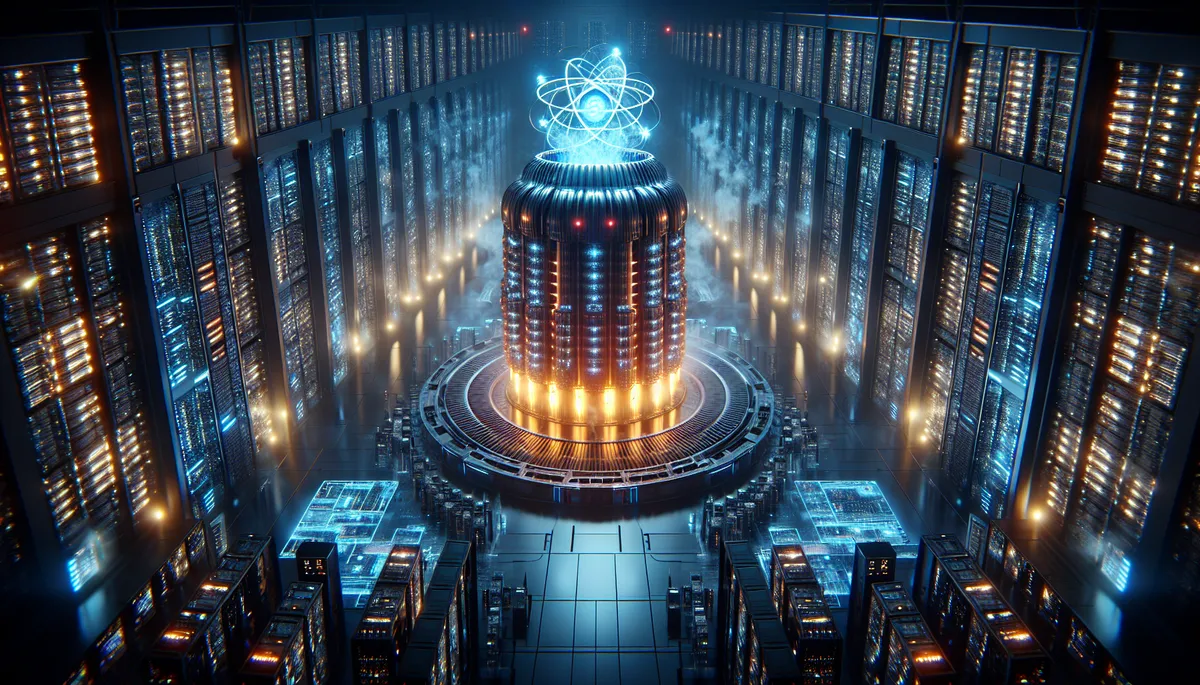
Meta’s 6.6 GW Nuclear Strategy: From TerraPower to Vistra
Meta has staked the most aggressive claim in the nuclear power race. In January 2026, the company announced plans to secure 6.6 GW of nuclear energy by 2035, making it one of the world’s largest corporate buyers of atomic power. The strategy rests on three major partnerships that span both next-generation reactor development and existing nuclear capacity.
The first partner is TerraPower, the Bill Gates-backed reactor company. Meta agreed to help fund the development of two Natrium reactors capable of providing 2.8 GW of baseload power and 1.2 GW of energy storage capacity. The second partner is Oklo, which will develop a 1.2 GW nuclear technology campus in Pike County, Ohio, with a target of going online by 2030.
The third leg is Vistra, an established utility operator. Meta signed 20-year power purchase agreements for 2.1 GW from three existing nuclear plants — Perry and Davis-Besse in Ohio, and Beaver Valley in Pennsylvania — with an additional 433 MW in uprate capacity planned for the early 2030s. Joel Kaplan, Meta’s Chief Global Affairs Officer, stated that “nuclear energy will help power our AI future, strengthen our country’s energy infrastructure, and provide clean, reliable electricity for everyone.”
Beyond these three partnerships, Meta separately signed a 20-year power purchase agreement with Constellation Energy’s Clinton Clean Energy Center in Illinois for 1.1 GW. That single deal generates $13.5 million in annual tax revenue for the state — a concrete illustration of how nuclear power contracts create economic value beyond electricity.

Amazon, Google, and Microsoft: The Nuclear Arms Race
Amazon’s nuclear power strategy is built on two pillars: next-generation reactors and legacy plant capacity. The company partnered with X-energy to deploy more than 5 GW of small modular reactors across the United States by 2039. Simultaneously, Amazon secured 1.9 GW through 2042 from Talen Energy’s Susquehanna nuclear plant in Pennsylvania, complementing a planned $20 billion investment in AWS data center facilities in the same state.
Google has taken a different approach, focusing on smaller, faster-to-deploy reactor designs. The company signed a 500 MW pipeline agreement with Kairos Power for six small modular reactors, targeting first commercial operation by 2030. A separate deal with Elementl Power covers three or more advanced nuclear sites, each with a minimum capacity of 600 MW — adding at least 1.8 GW to Google’s nuclear portfolio.
Microsoft has arguably built the most ambitious energy portfolio of the four. The company partnered with Constellation Energy on a $1.6 billion project to restart the Three Mile Island nuclear plant by 2027, transforming the site of America’s worst nuclear accident into an AI power station. Microsoft also signed the world’s first commercial fusion power purchase agreement with Helion Energy — a bet on an energy source that does not yet exist commercially.
$300B AI Investment Surge: 150% Record as 95% See Zero ROI
What Is an SMR? The Rise of Small Modular Reactors
Small modular reactors, or SMRs, are next-generation nuclear plants designed to be built in factory-assembled modules and deployed incrementally. Unlike traditional large-scale nuclear plants that take a decade or more to construct, SMRs can theoretically be scaled by adding modules as demand grows. According to Wood Mackenzie, the global SMR pipeline stood at 47 GW as of Q1 2025, with more than 50% of that capacity concentrated in the United States.
The critical link between Big Tech and SMR development is financial. Shioly Dong, a senior analyst at BMI (a unit of Fitch Solutions), noted that tech companies “create the revenue certainty that commercial banks will require for construction debt.” In other words, when Meta or Amazon signs a 20-year power purchase agreement, that contract becomes collateral that makes bank financing viable for reactor construction projects that would otherwise be too risky to fund.
This financial dynamic is transforming the nuclear power industry’s relationship with capital markets. Tess Carter, associate director of energy and climate at the Rhodium Group, observed that “banks are becoming interested in deal-making, representing significant development we haven’t previously witnessed.” The takeaway: Big Tech’s long-term contracts are not just buying electricity — they are restructuring how nuclear projects get financed.
The $300B Catch: Zero Commercial Reactors Delivered
Behind the headlines of multi-gigawatt contracts lies a sobering fact: not a single next-generation reactor developer has achieved commercial production. Every SMR deal signed by Meta, Amazon, Google, and Microsoft is effectively a pre-order for technology that does not yet exist at commercial scale. The entire 47 GW global SMR pipeline requires an estimated $300 billion in investment to materialize, and new projects will not connect to the grid until the 2030s at the earliest.
Why this matters: the nuclear power industry has a long and painful history of cost overruns and schedule delays. David Wilson, CEO of Energy Exemplar, warned bluntly that “nuclear has had many false starts.” Past attempts at a nuclear renaissance — most notably in the United States and Europe during the 2000s — collapsed under the weight of ballooning construction budgets and regulatory hurdles.
The labor challenge adds another layer of risk. Nuclear plant construction requires specialized electricians and pipefitters — the same skilled tradespeople that the data center construction industry is already competing to hire. Tim Winter, a portfolio manager at Gabelli Utilities Fund, framed the stakes clearly: “The industry needs someone to absorb cost overrun and delay risks — hyperscaler willingness determines sector boost magnitude.”
Rate Hike Odds Hit 14%: Fed’s March Minutes Flip 2026 Script
Three Mile Island Reborn: America’s Worst Nuclear Accident Site Becomes an AI Power Plant
In 1979, a partial meltdown at the Three Mile Island nuclear plant in Pennsylvania became the worst nuclear accident in American history. Nearly five decades later, Microsoft is spending $1.6 billion with Constellation Energy to restart the facility, targeting a 2027 reactivation date. The plant will supply carbon-free electricity to Microsoft’s expanding constellation of AI data centers.
The symbolism is hard to miss. The very site that turned an entire generation against nuclear energy is being reborn as infrastructure for the most transformative technology of the current generation. Microsoft is betting that the public perception of nuclear power has shifted enough — driven by climate urgency and AI energy demand — to make the restart politically and commercially viable.
But Microsoft is not stopping at fission. The company’s power purchase agreement with Helion Energy represents the world’s first commercial fusion energy deal — a commitment to buy electricity from a technology that has never produced net energy at scale. Put simply, Microsoft is hedging its nuclear bets across two entirely different branches of atomic physics: proven but stigmatized fission for the near term, and theoretical but transformative fusion for the long term.
The 2035 Horizon: How Nuclear Power Reshapes the Energy Map
According to a Deloitte analysis, nuclear energy could supply 10% of all data center electricity by 2035. Reaching that threshold requires three variables to align simultaneously: regulatory approval for new reactor designs, successful technology validation at commercial scale, and a sufficient pipeline of skilled construction workers to build the plants.
The financial signals are turning positive. Rhodium Group’s Tess Carter noted that banks are now actively engaging in nuclear deal-making — a development she described as “significant” and unprecedented. Big Tech’s 20-year power purchase commitments are functioning as de facto loan guarantees, giving institutional investors the revenue certainty they need to participate in nuclear construction financing.
The structural logic is compelling: hyperscalers need more power than any other energy source can reliably deliver, and nuclear is the only carbon-free option that runs 24 hours a day regardless of weather. If the SMR pipeline delivers even a fraction of its promised capacity, the global energy mix will shift in ways that affect electricity prices, carbon emissions, and grid reliability for decades to come.
Big Tech’s nuclear power bet is the most consequential energy decision the technology industry has ever made. It is also a $300 billion wager on reactors that have never been built, technologies that have never been commercialized, and a construction workforce that does not yet exist at the scale required. Two milestones will determine whether this bet pays off: whether Kairos Power delivers its first SMR by 2030, and whether Microsoft’s Three Mile Island restart meets its 2027 deadline.
References
- Meta Official Announcement (2026-01-09) — Meta secures 6.6 GW of nuclear energy contracts through 2035
- Meta Official Announcement (2026-01-09) — TerraPower 2.8 GW, Oklo 1.2 GW, and Vistra 2.1 GW partnership details
- Trellis.net (2026-04-10) — Amazon’s X-energy 5 GW SMR plan and $20B Pennsylvania investment
- Trellis.net (2026-04-10) — Google’s Kairos Power 500 MW pipeline and Elementl Power contracts
- Trellis.net (2026-04-10) — Microsoft’s $1.6B Three Mile Island restart and Helion Energy fusion deal
- Trellis.net (2026-04-10) — Global SMR pipeline at 47 GW; $300B investment required
- Insurance Journal (2026-04-10) — EIA power demand forecast and next-gen reactor commercialization status
- IAEA (2026) — Global data center power consumption projection: 460 TWh to 1,000+ TWh
- Trellis.net (2026-04-10) — Deloitte: nuclear could supply 10% of data center power by 2035
- Insurance Journal (2026-04-10) — BMI and Rhodium Group expert analysis; workforce shortage warnings
Stay Ahead of the Curve
Get the latest insights on AI, tech, and markets — delivered in both Korean and English.

Jugger | Backend Developer
A backend engineer working in enterprise solutions software since June 2021. The hands-on perspective from system design, API implementation, and production operations directly informs this site’s
AI, IT, and cloud infrastructure coverage.
For topics outside direct professional experience—blockchain and macroeconomics—analysis is built on primary-source citations such as SEC filings, whitepapers, institutional research, and government
statistics. Speculation is clearly separated from verified fact, and unverified claims are not published.
AI tools assist with drafting, but every article is reviewed, revised, and verified before publication. Errors are corrected with visible notes when discovered.
Contact: jjunggulee@gmail.com