- Novo Nordisk has partnered with OpenAI for enterprise-wide AI integration across drug discovery, manufacturing, and supply chain — with full global deployment targeted by the end of 2026.
- Rival Eli Lilly has already assembled a $3.75 billion AI portfolio through deals with Insilico Medicine ($2.75B) and NVIDIA ($1B), escalating the pharma AI arms race.
- AI-driven R&D could slash costs by 30–40% and compress development timelines from 6–8 years to as little as 30 months, with the global AI drug discovery market projected to reach $25 billion by 2035.
Drug discovery just entered a new era. On April 14, 2026, Danish pharmaceutical giant Novo Nordisk — the maker of Ozempic and Wegovy — announced a sweeping partnership with OpenAI to embed artificial intelligence agents across its entire operational chain. From genomic data analysis to supply chain optimization, every stage of how a drug is found, made, and delivered is now on the table.
The timing is no coincidence. Novo Nordisk is fighting to defend its first-mover advantage in the weight-loss drug market against an increasingly aggressive Eli Lilly, which has already locked in $3.75 billion worth of AI partnerships in 2026 alone. The OpenAI deal is Novo’s counterpunch — and it signals that the AI drug discovery arms race in pharma has officially begun.
What the Novo Nordisk–OpenAI Partnership Actually Covers
Strip away the press release language, and the scope of this deal is striking. OpenAI’s intelligent agents will be deployed across Novo Nordisk’s research and development, manufacturing, supply chain, and commercial operations — not as a pilot in one lab, but as an enterprise-wide transformation. Pilot programs launch immediately, with full global integration targeted by year-end 2026.

The AI applications span three critical domains. First, analyzing complex genomic, biological, and clinical trial datasets at a scale human teams cannot match. Second, simulating lab experiments to predict drug efficacy before physical samples are ever created.
Third, streamlining manufacturing and distribution logistics to accelerate the journey from lab bench to pharmacy shelf. Novo Nordisk CEO Mike Doustdar framed it bluntly: “Integrating AI in our everyday work gives us the ability to analyze datasets at a scale that was previously impossible.”
The partnership also includes workforce AI literacy training and the development of custom tools. All AI-based decisions will be governed by a data protection and human oversight framework designed to ensure ethical compliance.
Why Now: The Ozempic Maker’s Competitive Crisis
Novo Nordisk built its empire on obesity and diabetes treatments, most notably Ozempic and Wegovy. But that empire faces a growing threat. U.S. rival Eli Lilly has been steadily eroding Novo’s first-mover advantage in the weight-loss market, forcing the Danish company to launch a Wegovy pill in January 2026 as a competitive countermeasure.
The problem runs deeper than product launches. Traditional drug development takes an average of 6–8 years and costs upward of $2 billion per approved drug. Without fundamentally compressing that timeline, Novo risks falling behind on next-generation therapies while Lilly’s pipeline accelerates.
This is not Novo’s first foray into AI infrastructure. In 2024, the Novo Nordisk Foundation partnered with NVIDIA and Denmark’s Export and Investment Fund to establish the Danish Centre for AI Innovation, operating Gefion — Denmark’s first AI-ready supercomputer. The OpenAI partnership layers intelligent agent capabilities on top of that existing computational foundation.
1,503 Elo: Anthropic Dethrones OpenAI After 3-Year Reign
Eli Lilly’s $3.75 Billion AI War Chest
To understand why Novo moved, look at what Lilly has already done. In March 2026, Eli Lilly struck a $2.75 billion licensing deal with Insilico Medicine, securing exclusive worldwide rights to novel oral therapeutics discovered through Insilico’s AI platform. The deal is the largest AI drug discovery partnership in history by disclosed value.
Lilly’s AI spending did not stop there. In January 2026, the company established a $1 billion, five-year AI co-innovation lab with NVIDIA, deploying GPU-accelerated computing across its drug discovery pipeline. Separately, Lilly has commissioned Chai Discovery to build exclusive AI models trained on its proprietary biological data.
The takeaway: Lilly assembled a $3.75 billion AI investment portfolio in the first quarter of 2026 alone. Novo’s OpenAI partnership is a direct response — and the competition between these two pharma titans has expanded from the weight-loss drug market into a full-blown AI infrastructure arms race.
30 Months From Target to Trial: AI Drug Discovery in Practice
The race is accelerating because AI-driven drug discovery is no longer theoretical — it is delivering results. Insilico Medicine’s Rentosertib became the world’s first fully AI-designed drug to enter clinical trials, completing the journey from target identification to human trials in just 30 months. The traditional pathway takes 6–8 years.
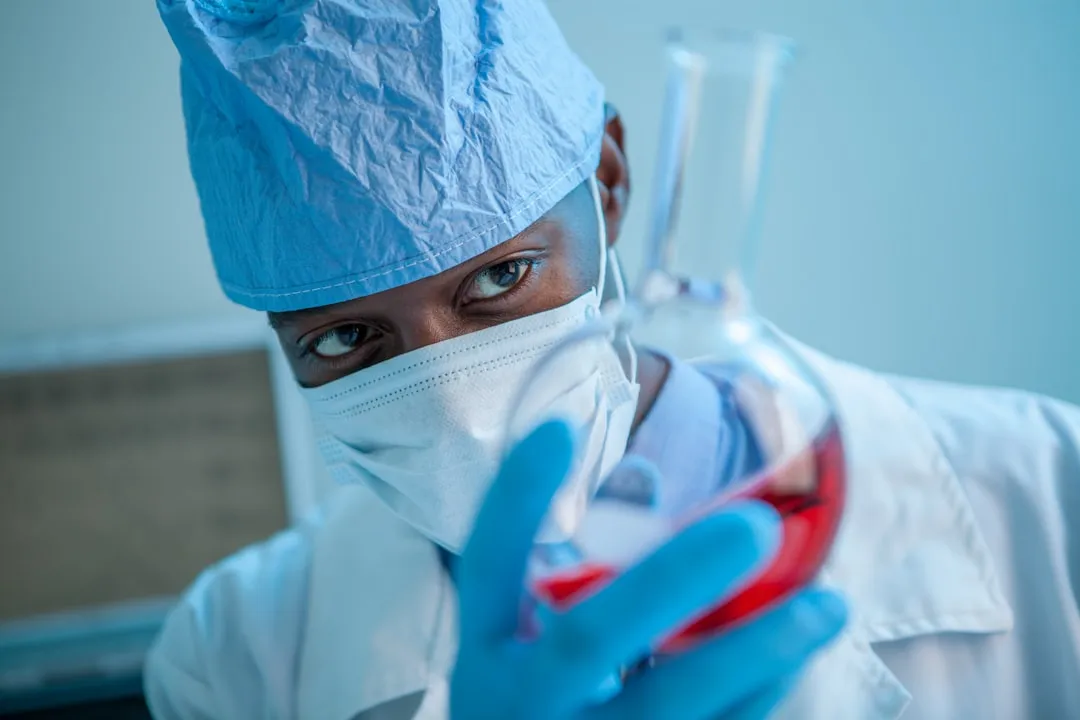
The cost implications are equally striking. Industry estimates suggest AI can reduce R&D expenditures by 30–40% while cutting clinical trial costs by up to 50%. Molecular simulation technology enables researchers to predict drug efficacy before creating physical samples, fundamentally altering the speed at which candidate compounds are screened.
OpenAI CEO Sam Altman described the broader vision: “AI is reshaping industries, and in life sciences, it can help people live better, longer lives.” Novo’s strategy is to combine these proven cost and timeline advantages with OpenAI’s general-purpose agent capabilities across its global operations. The partnership represents the clearest signal yet that AI-driven drug discovery has moved from experimental pilot to enterprise-scale deployment.
Market Outlook: From $8.6 Billion in 2026 to $25 Billion by 2035
Big pharma’s AI spending spree is fueling explosive growth in the drug discovery market. The global AI drug discovery market is estimated at $8.6 billion in 2026, growing at a compound annual rate of 12.6% to reach $25 billion by 2035.
Partnership activity tells the same story. The total value of big pharma–AI partnerships surged 120% year-over-year between 2024 and 2025. Beyond the Lilly and Novo headlines, Bayer signed a $1.5 billion alliance with Recursion Pharmaceuticals, while Novo Nordisk had a separate $2.76 billion partnership with Valo Health already on the books.
In other words, AI-powered drug development is no longer an experiment confined to a few early movers. It is becoming the baseline competitive requirement across the pharmaceutical industry.
The Novo–OpenAI partnership is the latest — and possibly most consequential — signal of that shift. For investors tracking this space, the pattern is clear: companies without a credible AI drug discovery strategy are falling behind, and the cost of catching up is measured in billions.
Three Risks Investors Should Not Ignore
For all the headline-grabbing deal sizes, investors need to weigh three structural risks before pricing in an AI-driven pharma boom. The first is regulatory uncertainty. There is no standardized FDA pathway for approving AI-designed drugs.
Guidelines for incorporating AI-generated data into preclinical and clinical frameworks are still evolving. Until regulators establish clear protocols, every AI-discovered compound faces an unpredictable approval timeline that deal announcements alone cannot de-risk.
The second risk is data quality. AI models are only as reliable as the biological data they are trained on. If training datasets are biased toward specific demographics or incomplete in their coverage of disease pathways, the resulting drug candidates may face efficacy limitations or unexpected safety signals in diverse patient populations.
Third, there is the overvaluation risk. A partnership announcement is not a revenue event. Clinical trial failure rates remain above 90% even with AI involvement.
The gap between signing a multibillion-dollar deal and generating actual drug sales can span years. Investors who conflate deal flow with clinical success are pricing in outcomes that remain fundamentally uncertain.
What AI Drug Discovery Means for Drug Pricing
If AI can cut R&D costs by 30–40%, will patients see lower drug prices? The honest answer: it depends entirely on pharmaceutical companies’ pricing strategies. Cost savings at the R&D level do not automatically translate into lower prices at the pharmacy counter.
That said, the structural dynamics are worth watching. When development timelines compress from 6–8 years to 30 months, companies can enter the market faster during their patent exclusivity window. The flip side: generic competition arrives sooner, creating long-term downward pressure on pricing for drugs that were developed using AI.
As AI-driven drug discovery success stories accumulate, healthcare ETFs and biotech equities may undergo a structural re-rating. If Novo Nordisk’s OpenAI integration delivers measurable results against Eli Lilly’s AI portfolio, the market cap gap between these two companies will shift accordingly. The numbers to watch: Insilico’s Rentosertib late-stage clinical outcomes and Novo’s 2026 year-end full integration milestone.
#1 on FLEURS at Half the Cost: Microsoft MAI Takes On OpenAI
References
- Euronews (2026-04-14) — Novo Nordisk × OpenAI partnership announcement, CEO quotes from Mike Doustdar and Sam Altman
- SiliconAngle (2026-04-14) — Partnership scope covering genomic analysis, manufacturing, supply chain, and 2026 year-end full integration target
- CNBC (2026-04-14) — Novo Nordisk’s competitive position in the weight-loss market versus Eli Lilly
- Euronews (2026-04-14) — Eli Lilly × Insilico Medicine $2.75 billion deal details (March 2026)
- 24/7 Wall St (2026-01-12) — Eli Lilly × NVIDIA $1 billion five-year AI co-innovation lab
- BioMed Nexus (2026-04) — Insilico Medicine Rentosertib, first fully AI-designed drug entering clinical trials in 30 months
- AI Magicx (2026-04) — AI-driven R&D cost reduction estimates of 30–40% and clinical trial savings of up to 50%
- Roots Analysis (2026) — Global AI drug discovery market projected at $8.6 billion in 2026, growing to $25 billion by 2035
- Pharmaceutical Technology (2026-04-14) — Big pharma–AI partnership spending surged 120% year-over-year between 2024 and 2025
- Euronews (2026-04-14) — Novo Nordisk Foundation × NVIDIA × Denmark’s Export and Investment Fund, Gefion supercomputer (2024)
Stay Ahead of the Curve
Get the latest insights on AI, tech, and markets — delivered in both Korean and English.

Jugger | Backend Developer
A backend engineer working in enterprise solutions software since June 2021. The hands-on perspective from system design, API implementation, and production operations directly informs this site’s
AI, IT, and cloud infrastructure coverage.
For topics outside direct professional experience—blockchain and macroeconomics—analysis is built on primary-source citations such as SEC filings, whitepapers, institutional research, and government
statistics. Speculation is clearly separated from verified fact, and unverified claims are not published.
AI tools assist with drafting, but every article is reviewed, revised, and verified before publication. Errors are corrected with visible notes when discovered.
Contact: jjunggulee@gmail.com